 54° and Clear
Image
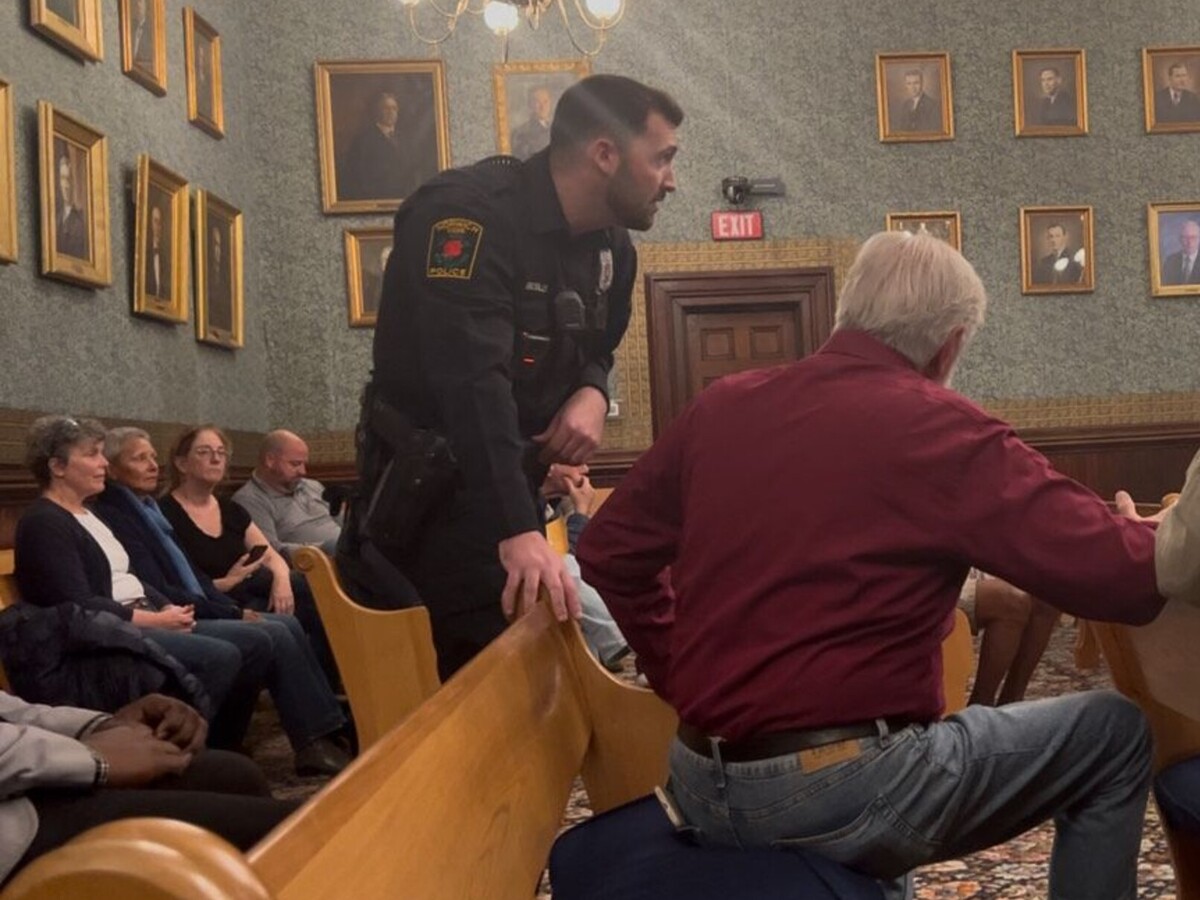
Police interaction during council with Rocky



Norwich, CT - the charming town featured in several movies including at least one Hallmark movie is plagued with high taxes, wasteful spending, blight, addiction, and crime. This is no Hallmark movie! One key issue is lack of representation for the general public by elected officials.
The mayor, Peter Nystrom, who was ineligible for another mayoral run won a seat on council in 2025. As mayor, Nystrom, along with council required anyone speaking during council to disclose name and address. This requirement may seem reasonable to some, but the information is collected, entered into minutes with summary of what was discussed and made publicly available.
Additionally, the information is included in videos released by the city of Norwich. This type of doxxing records: Who spoke, the speaker's address, and summary of what was spoken - publicly.
Do you have a right to opt out?
While there is no explicit opt-out clause, the short answer is Yes. If you opt out, you are not "allowed" to speak.
What's the issue with giving your information?
Requiring public disclosure of name and address during city council meetings:
* Conflicts with First Amendment protections for anonymous or pseudonymous political expression
* Violates reasonable expectations of privacy in an era where online records are permanent
* Discourages participation, especially from vulnerable or dissenting individuals
* Fails the test of narrow tailoring — there are less invasive ways to verify residency or identity
The City of Norwich Council recently amended its rules of procedure to require anyone speaking during the public comment period to state their full name and home address. The rule appears to apply inconsistently — enforced for some speakers but not all — and the personal information collected is later published online in official meeting minutes and video archives.
Privacy advocates warn the new policy could expose residents to safety risks and discourage participation. In several other states, residents are allowed to withhold personal information or have “opt-out” protections under privacy laws that prevent the release of home addresses in public records.
During the October 20 meeting, the council voted 7-0 to close public comment early, cutting off several residents who had intended to speak. One regular attendee, known locally as “Rocky,” objected, saying, “So I can’t speak!” Update 15:33 Rocky's exact words were:
"We have a right to address our grievances with the government. It's in the constitution of the United States of America!"
The 7-0 motion to close citizen comment completed, Rocky stated again he had the right to speak. Rocky asked,
"Sir, we have the right to redress our grievances. How am I going to do that? How?"
Mayor: No more outbursts.
Rocky: Or what?
Mayor: Officer, remove him.
Rocky: Excuse me, Am I breaking the law?
Mayor: It's called disorderly conduct, disturbing the peace.
One resident citizen commented: The hell it is.
Police were called after the mayor declared a No charges were filed, but the police response alarmed attendees who viewed it as an unnecessary escalation.
Coverage by The Day newspaper focused largely on alleged disruptions by residents, while critics say the story overlooked the broader issue — the potential infringement of citizens’ rights to privacy and free expression at public meetings.
Expert Perspectives
Dr. Jane Bambauer, a law professor who teaches media, privacy and First Amendment law at the University of Florida, explains:
“When government-run meetings require participants to supply detailed home address information and then publish it, you shift the dynamic from a civic forum to a surveillance-enhanced forum. Speakers aren’t just speaking — they’re revealing location data that stays on record. That naturally chills participation, especially for dissenting voices.” (See her work on privacy and First Amendment dynamics.) Hoover Institution+2Hoover Institution+2
Eugene Volokh, a prominent First Amendment scholar and senior fellow at the Hoover Institution, adds:
“Anonymous or pseudonymous political speech has long been protected because it enables robust public debate free from fear of retaliation. Requiring names and addresses for speakers in a public forum imposes a burden that may not be justified unless the government demonstrates a narrowly tailored interest.” (See his analysis of free speech versus informational privacy.) UC Berkeley Law+2Hoover Institution+2
Dr. Neil Richards, a law professor at Washington University and a recognized privacy law expert, points out the link between privacy and free expression:
“Privacy is not simply a separate value from free speech; it underpins it. If speakers know that every detail they share will be permanently and publicly tied to their home address, the safe space for open civic commentary shrinks. That’s particularly true in digital-archived forms of government meetings.” (See his work on “Intellectual Privacy.”) Stanford CIS+1
Author Marcia Wilbur, privacy and free speech advocate - resident of Norwich, CT states this is a privacy and free speech issue:
"The entire issue is absolutely ludicrous. This is blatant disregard of 1st Amendment rights as well as a privacy risk to locals. I often state: Ignore your rights, They'll go away!"
What’s at Stake
Privacy & safety: Publishing full home addresses tied to speech creates a searchable, persistent link between individuals and what they say in public meetings. That exposure can lead to harassment, doxxing, or targeting of speakers.
Free speech & access: When residents know their identifying details will be permanently public, many may choose not to speak — especially those voicing unpopular views, vulnerable populations, renters, employees criticizing local policy, or those needing anonymity for safety.
Uneven application: The policy appears to apply selectively (“some, not all speakers”), raising concerns about fairness and principle of consistent public-forum rules.
Public comment closure + law enforcement involvement: The 7-0 vote to end public comment early, combined with law-enforcement presence when a speaker objected, heightens concerns that the civic forum is being restricted rather than expanded.
Call to Action
Civic organizations, residents, and the City Council MUST consider revisions such as:
Requiring only a speaker’s name (and perhaps a neighborhood or ZIP code), not a full home address.
Verifying residency privately (if needed) instead of publishing full address publicly.
Allowing opt-out or partial-disclosure options for speakers who fear adverse consequences.
Ensuring public comment sessions are not closed prematurely and that law-enforcement involvement is limited to clear disruptions, not speaking objections.
By adopting such adjustments, the city can protect privacy and promote free speech — making the public meeting truly open, safe, and inclusive.
"They use force to make you do what the deciders have decided you must do" - Rage against the Machine.
About the author: Marcia Wilbur, a Norwich, Connecticut–based privacy and free speech advocate, writes about the intersection of technology, transparency, and civil liberties. Her past work includes: Volunteer at Electronic Frontier Foundation, Digital speech advisory committee member at the Free Software Foundation, developer of free and open source software privacy=centric AI tools for GNU Linux, presenter at Yale Law School, presenter at HOPE hacker conference in NYC and author of DMCA, A Decade of the DMCA and in your pocket - the DMCA. Marcia, advocate and previous candidate for mayor, was raised in Norwich, CT.

Relatively new here, our prior 19 years were spent in a small Massachusetts town. Where they asked for your name and address before you could speak at a town select meeting. Some people didn't like that of course, so was a frequent issue that people complain about. I feel like Requiring only a speaker’s name (and perhaps a neighborhood) should be enough to protect the speaker and fulfill the obligation to be allowed to speak at City Council meetings.
As a former employee, I have witnessed firsthand the bias that comes from a forceful exchange in council chambers. Rocky is correct and Legal Scholars will attest to the need for and protections of anonymous free speech. The GOP Council members have historically shut down dissenting opinions when forcefully delivered. They fail at representing the people when this happens. I would like to see a member of the council amend this rule to include any persons right, as allowed by the 1st Amendment to express themselves as they wish without the need to get on record, and I am not surprised that Nystrom shut him down.


Relatively new here, our prior 19 years were spent in a small Massachusetts town. Where they asked for your name and address before you could speak at a town select meeting.
As a former employee, I have witnessed firsthand the bias that comes from a forceful exchange in council chambers. Rocky is correct and Legal Scholars will attest to the need for and protections of anonymous free speech.

Sunny, with a high of 64 and low of 39 degrees. Sunny in the morning, clear in the afternoon and evening,
We moved to Norwich in Aug 2023 and sat that local election out, this will be our first. Having done my research the most obvious conclusion I have so far is that one candidate for Mayor in 2025 has never done anything to make Norwich more affordable during his time serving on the City Council.

Great information, thanks for sharing. Got me to do a little research. Not a ton of info found so far, but did find this from 2018:

Moved here a couple years back from Massachusetts, and we really like living in Norwich. One of the first things I did when we moved in, I sent my info in to volunteer for the baseball stadium authority. Obviously I never heard back, Norwich abandoned that group years back and let the stadium go into bad shape.


A couple of points...
Yes, it is true that American Rescue Plan funds may very well have been re-allocated for other uses, but they weren't. The objections opposing their reallocation should have been objected to when the City Council was presenting it.
And had I not been in the hospital at the time I would’ve been glad to object it but that’s what happened. Of course, those reallocation should’ve never happened in the first place if we had an ethical committee.
Thanks Marcia! We are onboard with the boycott.
Also will point out that I found these arguments made here in opposition to the boycott to be very unconvincing.


